Showing posts with label PEN. Show all posts

Thursday, 11 February 2016

Olympus PEN-F - part 6 of my personal narrative, The Finale

Part 1, Part 2, Part 3, Part 4 and Part 5 precede this article.

Summarising and Tidying Up: What I liked.

I started by saying that the Olympus PEN-F is a controversial camera. Do I still think so after some days looking at my images, interacting online? Yes, I do. Briefly

It's a nicely responsive camera, with strong retro design hints.
"The camera part just gets out of the way and lets you concentrate on shooting." (Ming Thein).
It has milestone enhancements in "studio in the field" JPEG customisation so that you can pre-visualise the "look" of the photo instantaneously and intimately whether you want to save the JPEG as a keeper or use the raw for processing in Olympus Viewer or your third party workflow. Olympus innovated with the the S curve Shadow+Highlight adjustment and then subsequently the Color Creator a few models ago. Now the S curve has Midtone adjustment in addition to S & H. And the Color Wheel in the Color Profiles has a rainbow of individual colour adjustments. There is Vignette and Film Grain emulation in the Monochrome Profiles. And..... On Olympus Viewer, you can combine an Art Filter with Color Profile (can't check that on the body because I don't have one).


Phew! The noon day tropical sun so hot and glaring

Regardless I will be there.

We still run the old skool way.


The EVF is offset unlike a faux DSLR - it allowed me to keep both eyes open for a few lenses (mind needs some control) so I would observe more of the scene with one eye and ensure AF got the focus right with the other eye. It gave me confidence in the street with the camera raised to the face, something I feel nervous about with a faux DSLR in street photos of people.


You taking a photo of me?

What I would have preferred

A less obvious and more easily surreptitious simple hinged flip LCD screen (rather than the flip & twist screen that would be very useful on a faux SLR like the OM-D series. (By the way, the flip and twist is fitted on the old E-620, the E-3, E-5 DSLRs). I just figured out why they chose this flip and twist design though. For a little camera like this, with a target audience of travellers, genteel tourists, it needs to do selfie duty.


The Selfie with the Fishie

I would guess as with most middle income enthusiasts, I'm on a 2 to 3 year gear refresh - the need to save for family and extended family expenses and so on. My OM-D E-M1 purchase was recent in relative terms, so I'll have to wait. The price for the PEN-F is not low at retail and pre-order launch - there's a lot of nice stuff in it and there are return of investment costs that Olympus has to recover. There are cheaper cameras. There are surely more expensive cameras. And there are cameras whose bling value is higher than their utility value. The PEN-F has a lot of "I like it value"


I don't think I could buy one even if I sold the shirt off my back
Or sold my snaps on the sidewalk
Starting up an Institute might do it


Prayers wouldn't go astray for sure

Reasons people make up for not buying the PEN-F

From the range of feedback and comments, I thought I would summarise the vibe

The PEN-F is not weather sealed

For whatever reason if you must have weather sealing, this isn't the camera for you. Some people must have a Toyota Kluger 4WD instead of European luxury car. Different strokes for different folks. For your weather sealed body though, these products are designed to a test condition. Weather sealing is not an absolute. FYI.

The PEN-F breaks the mold of cheaper PEN prices

The PEN E-P5 was not "cheap". In contrast to the OM-D E-M10, it did not have the slant of features to distinguish it from the lowered prices of the OM-D E-M5 old stock and the E-M10. It didn't sell well at recommended retail price but towards the end, the prices were so discounted that people managed to get their hands on the E-P5 and love it for the shape in street shooting and travelling.

The PEN-F to me, is a much stronger product with stronger slants towards its intended audiences. I hope it does well. It's not a Sony with a wood grip. Or machined out of solid metal. 

On a features matrix on a web page, the PEN-F has nothing really different from the OM-D E-M5 Mark II

Probably. Have you got the right features in the matrix? Or is the left column a list of faux DSLR design features? Like a big grip to balance the 300mm f/4 M.Zuiko lens. Or Phase Detect so that the body can focus a Bigma. The PEN-F isn't a faux DSLR.

You don't have a skirt. Or wear tight pants, a lumberjacket and have a beard.

So sorry for you. But you don't have to wear a skirt. Or tight pants, lumberjacket and a beard. Look, I held a PEN-F for some hours. Nuts still feel ok. Voice hasn't changed an octave higher.

Will you tell the CEO or shall I?

Be Happy. Enjoy Your Day


Sunday, 8 June 2014

My personal settings for the Olympus E-PM2

I feel that one sweet feature of Olympus Interchangeable Lens Cameras is the MySet feature– it asllows you to set up several profiles and switch between them quickly as the situation changes. I evolve my preferences over the years and often forget why or what I have chosen. One thing that might improve the menus for me is if we could change the labels from MySet 1 to General Use or phrases like that.

MySet 1 – For general use

Feature Setting Rationale
Metering ESP ESP is an intelligent matrix pattern – and each model improves on this smart scene assessment of exposure.
Face Detect Off When pointing the camera at a crowds, the camera cannot know which face to give priority focus to.
AF Points Single. Centre I like shooting shallow DOF for tele and I like to choose which subject is more important for wide views.
Fn button assignment Magnify The E-PM2 does not have many Fn buttons to assign. So I use the only Fn button for LCD magnification when using manual focus lenses.
AEL / AFL S2/C2/M2 For S-AF – Press Half Way S-AFPress Fully lock exposure calculation and trigger the shutter
Record Button Starts Movie Recording
Full Time AF On
Back Dial Normal Operation

MySet 2 – For “Split Focus and Shutter Trigger buttons” – emphasise focus control

Feature Setting Rationale
Metering ESP
Face Detect Off When pointing the camera at a crowds, the camera cannot know which face to give priority focus to.
AF Points Single. Centre I like shooting shallow DOF for tele and I like to choose which subject is more important for wide views.
Fn button assignment Magnify The E-PM2 does not have many Fn buttons to assign. So I use the only Fn button for LCD magnification when using manual focus lenses.
AEL / AFL S3/C3/M3 For S-AF – Press Half Way – lock exposure calculation
Press Fully – trigger the shutter
Record Button AEL/AFL Initiates S-AF
Full Time AF Off I don’t want the camera to focus by itself.
Back Dial Locked

MySet 3 – For impromptu portraits

Feature Setting Rationale
Metering Centre Weighted I want to give the face exposure importance.
Face Detect Face and Eye Priority Sometimes I just want the camera to pick the face accurately, assuming I have only one subject.
AF Points Single. Centre I like shooting shallow DOF for portraits
Fn button assignment Magnify The E-PM2 does not have many Fn buttons to assign. So I use the only Fn button for LCD magnification when using manual focus lenses.
AEL / AFL S1/C1/M1 For S-AF – Press Half Way – lock exposure and initiate S-AF
Press Fully - trigger the shutter

Record Button Starts Movie Recording
Back Dial Normal Operation

MySet 4 – Monochrome – street scenes and portraits in general

Record Button
Feature Setting Rationale
Metering ESP
Face Detect Face and Eye Priority Sometimes I just want the camera to pick the face accurately, assuming I have only one subject.
AF Points Single. Centre I like shooting shallow DOF for tele and I like to choose which subject is more important for wide views.
Fn button assignment Magnify The E-PM2 does not have many Fn buttons to assign. So I use the only Fn button for LCD magnification when using manual focus lenses.
AEL / AFL S3/C3/M3 For S-AF – Press Half Way – lock exposure calculation
Press Fully – trigger the shutter
Record Button AEL/AFL Initiates S-AF
Back Dial Normal Operation
Picture Mode Monotone Sharpness +1
B&W Filter: Yellow
Curve Adjustment
-
   Shadows: 2 


If I had a MySet 5

For my manual focus Samyang 7.5mm fisheye, the enormous angle of view seems to fool the body Image Stabilisation – I must remember to set IS to Off and even then, set the IS Focal Length to 8mm. Watch out for some odd lenses – there may be some shutter shock coupled with the resonant vibration frequency of these lenses and using the back LCD, hands outstretched, I encounter image shake / blur even at fast shutter speeds of 1/200th sec. Having IS on confuses the issue – try it Off.

Sunday, 14 July 2013

The background behind the Olympus Micro Four Thirds cameras

Preamble

When you are more used to other brands (read Nikon or Canon) and decide to pick a camera from Olympus it can be initially confusing as to what model does what. It gets worse if you look at the older models (which are still on sale but production has ceased). Here're my insights.

Before the Beginning

Before the beginning of the Micro Four Thirds Standard, there was the Four Thirds Standard for DSLRs. Although this was grandly called a Standard, only a few brands sat at the Committee table. Olympus was the lead, Panasonic, co-leader. Sigma promised third party lenses, Kodak made a sensor or two (the E-1, E-500 had a Kodak CCD sensor), Panasonic made NMOS sensors and in collaboration with Leica, made some Lumix/Leica (affectionately called Panaleica). I think Samyang made manual focus lenses as well.

Olympus was keen on embracing Live View and competent Auto Focus in Live View. For that, they innovated the E-330 that offered two Auto Focus mechanisms - Live View A and Live View B.

The whole idea of Four Thirds with that infamously small sensor was that the lenses could be designed smaller, the body could be smaller and the sensor technology would advance to the stage that the difference between APS-C size vs Four Thirds size would not be significant to cause pain to the camera owner. The lens mount was brand new, all the lenses would be focus-by-wire instead of clunky mechanical coupling (since Olympus did not have a legacy of autofocus lenses) and this would offer brand differentiation and advantages over the other brands - at that time, Canon, Nikon, Pentax, Minolta.

Sadly, the idea was ahead of its time.  Financial year after financial year, there were losses - it's hard to take on the near duopoly of the big two. Although Olympus made a 3 tier model structure - Pro level, Enthusiast level and Entry level, all three levels failed to make inroads in the market. Technical handicaps were immature sensor technology, zoom lenses that refused to shrink and were not able to compete on price because of lower volume sales, bodies that lacked the AF finesse of the competition.

So the Micro Four Thirds Standard was born

Olympus finally decided to give up the Four Thirds DSLR line (including lenses) and embarked on niche market, knowing that it would eventually grow. This is Micro Four Thirds. It does not have a mirror box and the body shrinks considerably.

When they built and sold the Four Thirds DSLR lenses, they could not foresee the motor and mechanical performance needed to work fast with the Micro Four Thirds adoption of Contrast Detect Auto Focus (DSLRs use Phase Detect Auto Focus). For that reason, they had to build and sell all new lenses again. And amateur home movies had not become popular - newbies want movies that are Auto Focus, Auto Exposure, no sounds from lens motors during zoom and focus, no jumping of the image during zooming in the movie.

Note that with an electronically coupled Olympus or Panasonic lens adapter, Four Thirds DSLR lenses will drive and shoot on Micro Four Thirds bodies, but AF will be slow. And with the plethora of third party adapters, legacy manual everything film lenses can be fit onto Olympus cameras - exposure control can be set to Manual with metering or Aperture Priority.

Olympus decided not to tackle the Pro segment of the market because that is a high cost, low volume market requiring high performance, bright, fast AF lenses and high performance, robust, fast AF bodies. They knew their first Micro Four Thirds models would not have fast enough AF and they still produced the E-5, their last Four Thirds DSLR which was the best Pro level body they could make.

Panasonic decided that they would build all three tiers - Entry level, Enthusiast level and Professional level Micro Four Thirds bodies. Panasonic did not have a Pro level DSLR to keep alive nor did they have a sizeable DSLR owner base.

The Olympus model tiering

There have been several generations of Olympus Micro Four Thirds cameras. Olympus uses the phrase Olympus PEN to invoke nostalgia driven sentiment (they produced a legendary innovative half frame film camera called the Olympus PEN F) and styling clues.

There are three levels of PEN. The three levels are differentiated thus:
  1. The top PEN - the E-P model. This has enough buttons and dials, should exude some luxury feel in the hand and be the most styled cosmetically. It is not aimed at the Pro level of photographers.
  2. The middle PEN - the E-PL model. This body does not have the strong style emphasis. The body does not have to be especially thin. There will be less dials or buttons to distinguish it from the E-P model.
  3. The entry level PEN - the E-PM model. This body has markedly fewer buttons and dials - in fact, just one dial. It is assumed that price would be the major imperative with this model and owners would not normally be that keen to change camera settings between shots.
In the OM-D. Olympus decided that the technology had matured enough to aim for Enthusiast / Pro level market. This series has these features that the PEN range are not designed to have:
  1. Built in eye level Electronic Viewfinder
  2. Optional battery grips to allow longer sessions without needing to swap batteries, better ergonomics with larger lenses,  sometimes incorporating second shutter release button for portrait orientation shooting

Launch Dates and Reviews

Generation 1 E-620 DSLR
March 2009
E-P1
June 2009
DPR 
E-PL1
Feb 2010
DPR  

Generation 2 E-5 DSLR
Sept 2010
E-P2
Nov 2010
DPR  CL
E-PL2
Jan 2011
DPR   CL IR

Generation 3
E-P3
July 2011
DPR   CL  IR
E-PL3
July 2011
DPR  IR
E-PM1
July 2011
DPR   CL  IR
Generation 5
E-P5
May 2013
DPR  IR
E-PL5
Sept 2012
DPR  CL  IR
E-PM2
Sept 2012
DPR   IR
Current PEN

E-PL7
Sept 2014

Current OM-D
EM-1
Oct 2013
DPR  CL IR
E-M5
Feb 2012
DPR  CL  IR
E-M10
March 2014
DPR CL IR

Note: Dates generally from DP Review

Generation 1 - had sloooow AF. The sensor is a Panasonic sourced sensor.

Generation 2 - Quite improved AF. Accessory Port introduced.

Generation 3 - Very fast AF. Touch Screen for AF and control.

Current Generation PEN and E-M5 - First generation with Sony sourced sensor.  Very fast AF. Considerably better dynamic range, low noise high ISO performance. Fast stills frame rate.

New  Generation EM-1 - Phase Detect Elements on Image Sensor - Dual Fast AF system. AF that can handle legacy Four Thirds DSLR lenses comfortably.

Navigate to my Index of Articles on Olympus cameras

Saturday, 6 July 2013

Having fun with Fireworks

Coinciding with +City Of Melbourne What's On 's announcement of the Docklands Fireworks Season,  +Ockert Le Roux wrote a blog article to advise on techniques.  I missed the fun of last year with our gang and it wasn't raining yesterday so Ockert,  +Luster Lai and +Sophie Argiriou waited by the Cow In The Tree whilst I got myself in a standstill traffic jam at the end of Bourke Street.

I confess, I seldom do well at fireworks - it's a mental thing - Most defeated photographs happen in your head before you even press the trigger.. This time, I had a more positive outlook.

I started at f/11 but I moved onto f/22, the smallest aperture I could go, and the lowest ISO my camera could do -ISO 200, I didn't like bleached out trails and overwritten trails so on Ockert's advice of using a black masking board, I brought my Olympus polyprop environmentally friendly bag, tied the strings around the tripod head and laughed as I played peek-a-boo blacking out the scene between bursts. 

Oh and turned on Olympus's unique Live Time  - the feature that +Trey Ratcliff was asking for on his NEX. 

We could have gotten nearer. I could have swapped my DSLR 7-14 (used at 14mm) on the Olympus E-PM2 for the Panasonic 20mm prrime, to get more magnification. Even this is cropped a bit. But, hey, that event only takes like a few minutes and then it's over so what-the-heck, leave it alone. Let's set this one up for lots of negative space, shall we?

Does Live Time really help? It sure does. You can "see" when you are getting too many bursts superimposed and when the white trails which are so much brighter, are bleaching the scene so that you can end that frame and start a new one. 

But you must set the refresh frequency right. For this series of cameras, you can only refresh the LCD 24 times. If you set it at 2 secs refresh and you use a black mask in front of the lens to keep the exposure running but not take in more light, you could have the shutter open for way longer than 48 secs. (there is finite limit to the number of refreshes). Something like 4 secs at this fireworks density is about right - if you have more fireworks bursting per sec, then you may not hold the shutter open for that long).

And so, Enjoy!


Friday, 22 March 2013

Encounters with my fish

You know how when you buy something and then you notice that other people have the same thing? Like when you have an Olympus and you spot other people also have an Olympus? Or if you bought some red soles and other people also have a Christian Louboutin?


Well, I finally acquired a fish, something that I had been eyeing for a long time.


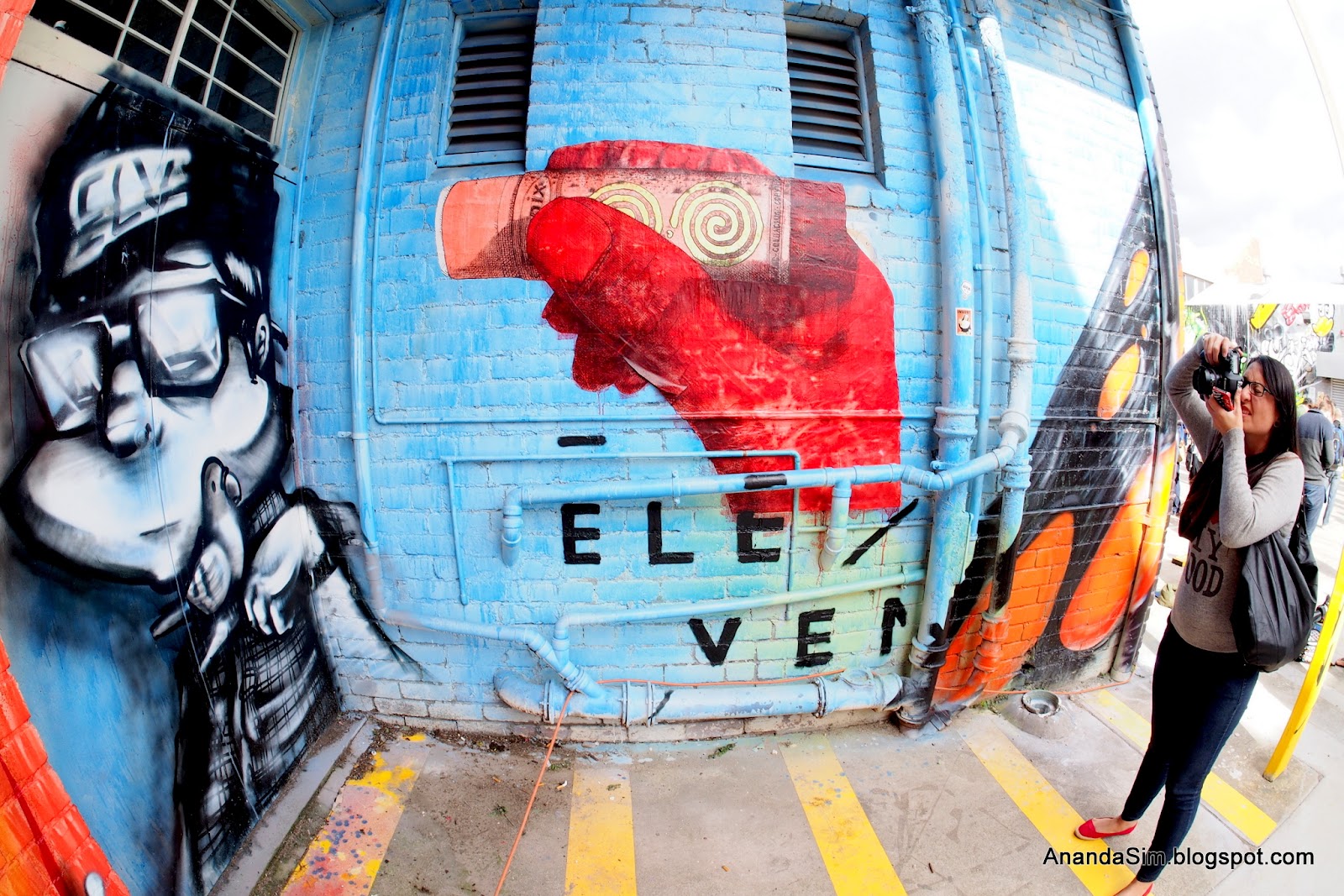
I was leaning close to a wall for photos of street art. With a fisheye, you get closer than Robert Capa would say "close enough".

A couple came by. I saw that she also had a camera, aiming at the wall and stepped back to give her space. She gave me a huge smile and said "my lens is very wide". I peered closely and I thought I saw a Canon fish.


I wonder how her photos turned out.

Monday, 14 January 2013

Olympus Mirrorless Camera Settings–Studio Electronic Flash

Updated: 15th January 2013
Camera settings are very subjective. This is my current profile for Studio shooting with Manual Electronic Flash Exposure

Camera: Olympus PEN E-PM2 – OM-D has more buttons and dials so adjust to taste

Premise

Scenario: Studio Flash work without ambient light. All flashes on manual control. Camera on manual control.

I assume that exposure settings are dictated by controlling the studio flash lights, lighting setup. Use the camera to vary f/no and ISO

These settings are so that the camera does not hamper your flow.

Exposure

Exposure Mode Set “M” for Manual explicitly You have the option of buying a brace of automatic TTL exposure flash units and use the camera to interact and control the flash power that way. This scenario is about using manual flash units, non TTL controlled.
Shutter Speed 1/250th Reduce the effect of ambient light. Check whether the light is even and not cut off
+Paul Pavlinovich advises that if you use mixed triggering (radio & optical) on differing lights, you could run into issues where something slows the triggering. 1/125th is normally assumed to be comfortable shake reduced speed and the max for focal plane shutter models is not 1/250th.
f/no Initially f/8 Adjust to taste - your flash power, flash proximity mix, ambient light will affect your choice

These accessible via SCP

ISO 200 initially Use electronic flash to avoid going high ISO. Also reduces effect of ambient light. Can't go lower on this model of camera.
WB Flash WB  
Flash 1/64th Power (settable when no flash mounted) else Full (third party external flash mounted) Does not affect wireless flash trigger. Reduces the impact of the little kit flash if using optical triggering.
Sequential shots Single  
IS Off  
Focus S-AF Centre Spot  
Face and Eye Priority On  

Via MENU

A. AF/MF > Full time AF Off  
A. AF/MF > AEL/AFL > S-AF Mode 3 (AEL/AFL – S-AF)  
A. AF/MF > AEL/AFL > MF Mode 3 (AEL/AFL – S-AF)  
A. AF/MF > MF Assist On  
A. AF/MF > […] Set Home Single Point AF  
A. AF/MF > AF Illumination On For darkened studio. Off if the subject complains of the glare in their eyes.
B. Button/Dial > Button Function > Fn Function AEL/AFL  
B. Button/Dial > Button Function > Movie Button Test Picture Or Magnify if using non electronic lens  
B. Button/Dial > Button Function > Cursor Pad Buttons Off Assuming that Dial Lock is Off and set to f/no control.
B. Button/Dial > Button Function > Dial Function f/no  
B. Button/Dial > Button Function > Dial Lock Off To allow changing f/no conveniently – might be touchy
B. Button/Dial > Displ / Sound / PC > Live View Boost On When set to Manual Exposure, the viewfinder may go dark in a darkened studio
B. Button/Dial > Displ / Sound / PC > Shutter Release Beep On  

If you want to contribute any tips and ideas, happy to hear from you

Wednesday, 18 July 2012

Life with a prime

I didn’t use a prime (fixed focal length) lens until early year, as my general, everyday use lens. Digital saw me with a 3x zoom on the Nikon 775 compact cam and then a 10x zoom on the Olympus C-750uz ultra zoom, then the 5x zoom on the Kodak P880. When I went digital, I had the two kit lenses on my E-510 and the story continued.

This year, David Williams introduced me to the 20mm f/1.7 Lumix pancake (40mm in old coin, film parlance) and 45mm f/1.8 Zuiko Digital (90mm in old coin). And I fell for these lenses. I wanted a shallower depth of field like in the film days plus more chance to take shots in dimmer light levels.

I fit the 20mm a lot – it allows closer camera distance, in fact, it forces a closer camera distance. And I switch over to the 45mm when I want some distance from the subject, when I have the space to back away or when I want to frame a tighter portrait.

Beginners to photography often gasp and say “What can I do without a zoom? I can’t live without one. Walking backward and forward isn’t an option I want to take or I have”. To that, I have to reply – what is impossible or immutable is only a state of mind, not an actuality of circumstances.

The honest gaze of sincere friend Kuan – we’ve known each other since University and now we’re apart except for the annual visit but we still find lots in common

The cup of Malaysian coffee is very important – after all, it’s a coffee shop. I didn’t develop a taste of habit for any kind of coffee. We used to have those old carved wood stools and marble seats, it’s been plastic chairs and melamine tables for a long while now. You’ve got to give the coffee a good stir of course, with the overflow dripping down the sides of the cup, otherwise it’s not authentic. The mouth expression in anticipation of before the event or savouring the taste afterwards.

The mahjong boys are back in town. Mahjong can be a gambling addiction and also a generational family and community pastime. Players and onlookers gaze in concentration and exclamations of animation abound when some event happens. Notice the half tiled wall (to save costs) and the unburied wire running (used to be stapled onto bulky wood runners, the modernisation brought PVC conduits. But then again, you could just run it along the wall.

The stand fan provides a breeze and if you are attired in a singlet, well that’s tropicalised wear for you.

Life goes way too fast in the concrete city staffed by Twenty-Somethings. It’s all hustle and bustle and winning the rat race except there are huge number of rats in the race.

When you’ve had your day in the sun, what you yearn for a nice tasty bowl of Yong Tau Foo. The slower you stir, the slower time passes, or so it seems. You can almost see some glimpses of past splendour and activity in the ripples and the reflections.

We close with a note to people who make such food happen. The lady below is peeling mengkuang otherwise known as Yam Bean. It’s good eaten raw, crunchy like an apple except that it is a root, not a fruit. It’s also the sweet taste in poh piah and joo hoo char

And, at the end of the day, we need money to survive. To keep the fridge stocked and running.

In the photos above, we’re not talking about action shots, urgent 5 frame per second shooting. These subjects are evocative, story telling. Yes, some of these shots are indeed cropped and a zoom might avoid that. But a zoom would, for the same price be darker, bigger, more clumsy – with these primes, you can make like you’re fiddling with your camera instead of framing up a shot.

Sunday, 15 July 2012

Memories of Dad

I’m here in Malaysia, where it all began so many years ago. And where I last saw Dad before his last rush to hospital. We’ve visited his resting place in Nilai a few times and it is peaceful there but that’s not what I preserve in my heart and my mind.
We used to go to Pudu wet market, we did.

Mum used to do all the heavy lifting – trudge into the wet places to buy chicken, eggs, meat and so on. The women of the household still do that. They used to wear local clogs and later on plastic washable sandals and they still do that.
Dad and I would wait in the cleaner areas and indulge in his passion for fruit – he was the gatherer of the fruits. I went to the place where we bought bananas and they still sell bananas there, but I don’t know the people, old or new.


It’s a darker corridor and there are side entrances
There were lots of things inside the dim market but as Mum did all the main shopping, I didn’t see the veil lifted. Shallots, spices and eggs.
There would be fish.
</>
And meatier stuff – curiosities like Pigs Ears.
If we stepped outside, we’d see all kinds of stuff on sale. Just because it’s a wet market doesn’t mean you only sell bloody meat or things that make you go Eeeuuww.
Flowers in garlands
As we walked back to the fringe, we would pass this Taoist worship ornaments shop
The shops by the road that sell fish are still there
Then Mum would still not have turned up. We would wait some more and see peddlars with fake Rolex watches (Dad always wanted a real one but settled for two Tissot in his life, he was realistic – his had a family to feed and two sons to send oversas to Uni on government officer salary). He would reward my patience with two types of Chinese pancakes – the thick and the thin types.
And sometimes, sometimes, I would catch a glimpse of something potentially scary and intriguing. The slaughter of a big lizard, turtle – often in a manner that might bring the RSPCA. Those days are gone of course, all you can see are frogs
The market is still full of wide eyed kids
and their Dad
And people who take might have the advantage of wide eyed adults
And that, is what memories of Dad and our time together is.
Thanks Robin Wong, Luke Ding, Yeow Chin Liang and all the gang for hosting the walk. And a hello to Mithun

Thursday, 10 May 2012

The Reflect Verb

Whoa, it's been quite a hectic period in my photography, thanks to Marg Wong, the fun gang at the Melbourne Photowalk on Google+ and encounters with the Melbourne Street Togs Facebook group.

I'm posting more and most of my photos more frequently to G+ (it's addictive) and my flickr account is languishing. Will have to correct that soon. Before I get waylaid by words (the downfall of several nights now, let me share my latest favourites.


This is my favourite from my walk along Toorak Road, South Yarra. Slightly darkened for the patina, hand held with the 20mm f/1.7 Lumix on my Olympus PEN E-PL1.

Since I got the lens, I've experienced a few answers to questions of image "look" (I refrain from using the often misconceived words image quality)


This second shot is the most bokelicious I've ever made.

More later...

Wednesday, 18 January 2012

The importance of being Earnest

Street Photography isn’t new. It’s as old as the redoubtable Henri Cartier Bresson or even Jacques Henri Lartigue. With Vivien Maier as a standout (who probably never made a cent from her passion) through to the current New Yorkers Joe Wigfall, Jamel Shabazz, Major Deegan. These guys have the magic of establishing relationship pretty fast, almost Yeow-like and Robin-esque. They engage pleasantly and comfortably with their human subjects, producing street portraits that are both impromptu and attractive. Quite the opposite style to in-your-face Bruce Gilden and the young exponent Eric Kim.

Sifu Yeow at work

The most approachable security guard I’ve met

Call me “Porkman”, he said.

How do you maintain a deadpan look of enquiry?

Shots of behinds don’t often work. I rather like this one

For human subjects, it’s particularly important to apply the golfer’s analogy instead of the tennis analogy – one has oneself to beat, not the competition. You’ve got to be comfortable in your skin and with your gear.

Endless debates cover:

  • the size of your camera
  • the size of your lens
  • the focal length to shoot at
  • the distance to shoot at
  • the risk of equipment loss through theft and mugging
  • whether you’re sucking the soul of the sitter through your lens can then selling it to the devil.

Only you can rationalise and emotivise your feelings. Only you can decide what style of human interaction works for you.

While you’re pondering that, take a look at David William’s work